Key points
- On September 15, 2026, Rep. Thomas Massie (R-Ky.) filed eight articles of impeachment against Defense Secretary Pete Hegseth and read them aloud on the House floor.
- Three articles accuse Hegseth of breaking the War Powers Resolution in the Iran war. The others cover civilian casualties, the Caribbean boat strikes, Sen. Mark Kelly, the Maduro raid and strikes in Yemen.
- Massie filed the resolution as privileged, which normally forces action within two legislative days, but the House left early for the midterm recess. It returns November 9.
- Speaker Mike Johnson calls the effort “a stunt” and says it will be tabled. The Pentagon and the White House say Hegseth has done “a phenomenal job.”
Republican Rep. Thomas Massie of Kentucky has moved to impeach a Cabinet secretary serving a president of his own party. His target is Pete Hegseth, who has led the Pentagon through the 2026 war with Iran. The resolution charges Hegseth with “high crimes and misdemeanors” on eight counts, most of them built on the 1973 War Powers Resolution.
A vote was supposed to come within days. Instead, House leaders sent members home early to campaign, and the fight now lands in the lame-duck session that begins after the November 3 election. This guide explains what each article alleges, the law behind it, what Hegseth’s defenders say, how impeaching a Cabinet officer actually works, and what can happen next. It is current as of October 22, 2026.
Hegseth impeachment at a glance
| Question | Answer |
|---|---|
| Filed | September 15, 2026, on the House floor |
| Sponsor | Rep. Thomas Massie (R-Ky.), a member of the House Judiciary Committee |
| Target | Pete Hegseth, Secretary of Defense (also titled Secretary of War since a September 2025 executive order) |
| Articles | Eight, covering the Iran war, civilian harm, boat strikes, Sen. Mark Kelly, Venezuela and Yemen |
| Status on Oct. 22, 2026 | Pending. The House recessed on September 16 and returns November 9 |
| Leadership plan | Speaker Johnson: “It will immediately be tabled” |
| To impeach | A simple majority of the House |
| To remove | Two-thirds of senators present at a Senate trial |
What the eight articles of impeachment allege
Massie’s office published the full 34-page text and a summary of each article. The table below follows that official summary; the full resolution adds the detailed findings.
| Article | What it alleges | Law it relies on |
|---|---|---|
| I | The Iran war was unlawful from the start: no declaration of war, no statutory authorization, no attack on the United States and no imminent threat | War Powers Resolution, section 2(c) |
| II | Hostilities continued after both chambers directed the removal of U.S. forces in H. Con. Res. 86 | War Powers Resolution, section 5(c) |
| III | Hostilities continued past the 60-day limit and any 30-day withdrawal period | War Powers Resolution, section 5(b) |
| IV | Disregard of laws meant to minimize civilian casualties | Statutes and directives on civilian harm |
| V | Lethal strikes on suspected drug boats replaced maritime law enforcement, killing at least 221 people, including strikes on survivors | Law of armed conflict; due process |
| VI | Pentagon power used to retaliate against Sen. Mark Kelly for his speech about unlawful orders | First Amendment |
| VII | Operation Absolute Resolve, the seizure of Nicolás Maduro and Cilia Flores in Venezuela, without constitutional or legal authority | Constitution, Article I war powers |
| VIII | Operation Rough Rider in Yemen launched without authorization, with reporting failures and civilian deaths | War Powers Resolution reporting rules |
“Secretary Hegseth is breaking the law and must be held accountable,” Massie said when he filed. On the floor he said Hegseth “has demonstrated that he will remain a threat to the Constitution, if allowed to remain in office,” and that the conduct warrants “impeachment and trial, removal from office and disqualification.”
The Iran war and the War Powers Resolution (Articles I to III)
The heart of the case is the Iran war. U.S. and Israeli strikes on Iran began on February 28, 2026, under the U.S. name Operation Epic Fury, without a vote in Congress. A ceasefire began in early April, a memorandum to end the war was signed on June 17, and the truce collapsed on July 8 after Iranian attacks on shipping in the Strait of Hormuz, according to Wikipedia’s timeline of the war.
The War Powers Resolution, passed over President Nixon’s veto in 1973, sets the rules Massie says were broken. The Congressional Research Service summarizes its three key parts:
- Section 2(c) lists when the president may send forces into hostilities: a declaration of war, specific statutory authorization, or a national emergency created by an attack on the United States.
- Section 4 requires the president to report to Congress within 48 hours of introducing forces into hostilities.
- Section 5(b) requires the president to end the use of forces after 60 days unless Congress authorizes it, with up to 30 more days to withdraw safely (50 U.S.C. § 1544).
- Section 5(c) lets Congress direct the removal of forces by concurrent resolution.
The 60-day clock ran out on May 1. That day the White House told Congress that “the hostilities that began on February 28, 2026, have terminated,” arguing the April ceasefire stopped the clock. Hegseth said, “We are in a ceasefire right now, which our understanding means, the 60-day clock pauses or stops.” President Trump added that “every other president considered it totally unconstitutional, and we agree with that,” PBS NewsHour reported. Sen. Richard Blumenthal (D-Conn.) answered that “there’s no pause button in the Constitution, or the War Powers Act.”
In June, Congress passed H. Con. Res. 86 directing the president to remove forces from hostilities with Iran. The Senate vote on June 23 was 50 to 48, with Republicans Bill Cassidy, Susan Collins, Rand Paul and Lisa Murkowski joining Democrats. Because it was a concurrent resolution, it was never sent to the president and is not legally binding, NPR reported. The Supreme Court’s 1983 decision in INS v. Chadha cast doubt on such “legislative vetoes,” which is why Congress now usually uses joint resolutions instead. On the day Massie filed, the House also passed a separate Iran war powers resolution, 220 to 204, with seven Republicans, Massie among them, voting yes.
Articles I to III turn that record into charges: the war lacked authority from the start, it continued after Congress directed withdrawal, and it ran past the statutory deadline. Hegseth’s defenders answer that presidents of both parties have treated the War Powers Resolution as unconstitutional, that the ceasefire ended the hostilities that started the clock, and that a concurrent resolution cannot bind the executive.
Civilian casualties and the Minab school strike (Article IV)
Article IV accuses Hegseth of disregarding laws meant to minimize civilian casualties. The incident most often cited by critics is the strike on the Shajareh Tayyebeh Elementary School in Minab, in southern Iran, on the first day of the war. Iranian officials put the death toll at 156, most of them children. Independent investigators identified a U.S. Tomahawk missile, and a UN fact-finding mission said in September that it had reasonable grounds to believe the United States carried out the strike, according to Wikipedia’s summary of the investigations and NBC News reporting on the strike.
In March, Hegseth said the United States was investigating and would “never target civilian targets.” President Trump first blamed Iran and later said “mistakes are made” and “nobody did that on purpose.” As of late September, the Pentagon’s internal investigation had not been released.
The Caribbean boat strikes (Article V)
Since September 2025, U.S. forces have struck vessels the administration says were smuggling drugs. Article V says those strikes replaced maritime law enforcement with “unauthorized lethal targeting,” killed at least 221 people, and included strikes on survivors and a failure to rescue the shipwrecked.
The most disputed strike came on September 2, 2025, when a follow-on attack killed two men clinging to the wreckage of a burning boat. The Washington Post reported that Hegseth had given a verbal directive to “kill everybody.” Hegseth called that report “fabricated” and said he was “not in the room” when the follow-on strike was launched; the White House confirmed he authorized Adm. Frank “Mitch” Bradley to conduct the strikes, States Newsroom reported.
The administration’s legal position is that the United States is in a “non-international armed conflict” with drug cartels it has designated as terrorist organizations, and that the people killed are “unlawful combatants.” Hegseth said the military has “the absolute and complete authority to conduct that.” Critics, including former State Department lawyer Brian Finucane, said the theory is “not supported by the facts,” CBS News reported.
Sen. Mark Kelly, Venezuela and Yemen (Articles VI to VIII)
Sen. Mark Kelly. In November 2025, Kelly and five other Democratic lawmakers released a video urging troops to refuse unlawful orders. Hegseth issued Kelly, a retired Navy captain, a censure letter on January 5, 2026, as a step toward possibly reducing his retired rank and pay. On February 12, U.S. District Judge Richard Leon temporarily blocked the Pentagon, finding it had violated Kelly’s First Amendment rights. Responding to the government’s argument, he wrote: “Horsefeathers!” (PBS NewsHour). Article VI calls the censure retaliation for protected speech.
Venezuela. On January 3, 2026, U.S. forces captured Nicolás Maduro and his wife, Cilia Flores, in Caracas in Operation Absolute Resolve, involving about 150 aircraft. They were flown to New York to face narco-terrorism and cocaine importation charges. The administration framed the raid as support for a law enforcement arrest, and Sen. Mike Lee said it “likely falls within” the president’s Article II power. Massie criticized it at the time, USNI News reported. Article VII calls it the “kidnapping of a sovereign foreign leader.”
Yemen. Article VIII charges that Operation Rough Rider, the U.S. air campaign against Houthi forces in Yemen, began without congressional authorization or an imminent threat, broke war powers reporting rules and caused civilian deaths.
What Hegseth’s defenders say
House Republican leaders oppose the resolution, and the administration has defended Hegseth:
- Speaker Mike Johnson called the resolution “a publicity stunt by someone who wants attention,” said it “will immediately be tabled,” and warned, “We should not be playing games with national security” (NBC). He called Massie’s effort “a stunt” and said Hegseth “has done an extraordinary job” (Newsweek).
- Attorney General Todd Blanche said at a White House briefing that “Secretary Hegseth is doing a phenomenal job, and the secretary of war doesn’t just go off and do things,” adding that “he follows the law” (WJLA, Scripps News).
- The Pentagon, through press secretary Kingsley Wilson, called Hegseth a “transformative leader” who “has slashed bureaucracy, unleashed innovation, and delivered for our warfighters every step of the way” (Semafor).
- On the law, across these episodes the administration and its allies have argued that the president has inherent Article II power to use force, that the War Powers Resolution’s deadlines are unconstitutional, that the April ceasefire ended the hostilities at issue, that the boat strikes are lawful acts in an armed conflict with designated terrorist cartels, and that the Maduro operation supported a lawful arrest.
Blanche’s remark points to a structural defense: most of the conduct in the articles carried out decisions made by the president, and defenders say a Cabinet secretary should not be impeached for executing the commander in chief’s policies. Supporters of impeachment answer that war powers limits and the law of armed conflict bind every official in the chain of command, not only the president.
How impeaching a Cabinet secretary works
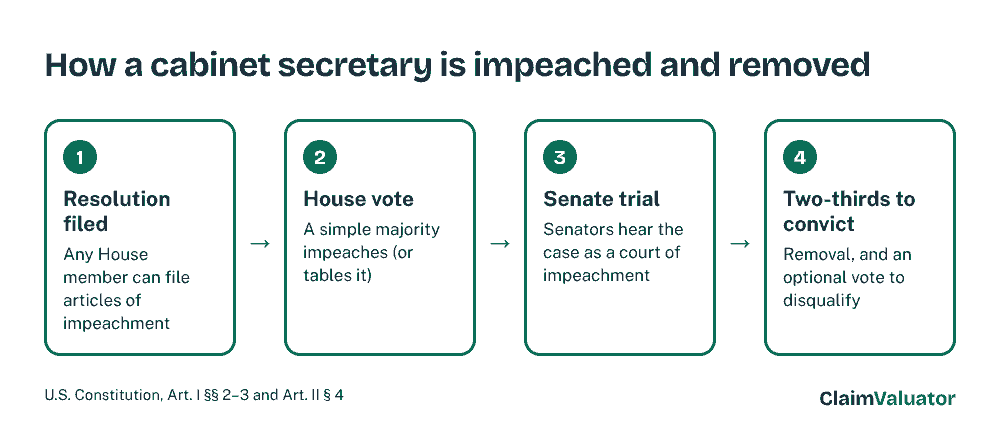
The Constitution says “all civil Officers of the United States” can be removed on impeachment for, and conviction of, “Treason, Bribery, or other high Crimes and Misdemeanors” (Article II, Section 4). A Cabinet secretary is a civil officer. The process has three stages:
- The House impeaches. Any member can offer an impeachment resolution as a question of privilege under House Rule IX. Leadership must then schedule it within two legislative days. The House can adopt it, refer it to the Judiciary Committee, or kill it with a motion to table. Each takes a simple majority.
- The Senate tries the case. Conviction requires “the Concurrence of two thirds of the Members present” (Article I, Section 3). With all 100 senators present, that is 67 votes.
- The penalty is limited. Judgment “shall not extend further than to removal from Office, and disqualification” from future federal office. By Senate practice, disqualification takes a separate majority vote. Criminal prosecution is a separate matter for the courts.
Only two Cabinet secretaries have ever been impeached. War Secretary William Belknap was impeached in 1876 after he had already resigned, and the Senate acquitted him. Homeland Security Secretary Alejandro Mayorkas was impeached on February 13, 2024, by a vote of 214 to 213 (Axios), and the Senate dismissed both articles without a trial on April 17, 2024 (Boston Globe). No Cabinet secretary has ever been convicted.
What makes Massie’s move unusual is party. Republicans did not want him to become the first member of Congress to try to impeach a Cabinet member of his own party, Scripps News reported.
Why the House vote was delayed
The timing was a surprise. Massie told reporters, “I didn’t give anybody heads-up.” He filed on the same day the House voted to table a separate resolution from Rep. Al Green (D-Texas) to impeach President Trump. Because Massie’s resolution was privileged, it set up a vote by Thursday, September 17. Instead, House leaders canceled Thursday’s votes and sent members home on September 16 for a seven-week campaign recess, pushing the vote past Election Day (NBC).
Johnson denied any link, saying, “It’s time for our members to go home to their districts and make the case to the American people.” Reporting at the time said leaders wanted to spare vulnerable Republicans a hard vote during an unpopular war. Massie, who lost his May primary to Trump-backed challenger Ed Gallrein, will serve the rest of his term as a lame duck.
On October 15, Massie raised the pressure again on X: “Trump should fire Hegseth to avoid Hegseth’s impeachment. It’s the honorable thing to do,” Benzinga reported. He has said he will press the impeachment when the House returns, whatever the election results. Democrats have moved closer to the effort: House Minority Leader Hakeem Jeffries says Hegseth should be fired, and Rep. Adam Smith (D-Wash.), the top Democrat on the Armed Services Committee, has signaled he could back Massie’s measure, while some Democrats are wary of voting on articles drafted by a Republican before any investigation, Semafor reported.
What happens next
The House is scheduled to return on November 9. From there, there are four realistic paths:
- A motion to table passes. This is Johnson’s stated plan. It ends this resolution with a simple majority, though Massie or another member could file again.
- The resolution is referred to the Judiciary Committee. Referral avoids a direct vote. The committee need not act, and unfinished resolutions expire when the 119th Congress ends on January 3, 2027.
- The House impeaches. That needs a majority. The case would then go to the Senate, where conviction needs two-thirds, a bar no Cabinet impeachment has ever cleared.
- Hegseth leaves office. A resignation or firing would likely end the push, although the Belknap case shows the House can impeach an official who has already resigned, mainly to seek disqualification.
Watch three things in the lame-duck session: whether Republicans who voted for the Iran war powers resolution also vote against tabling, how many Democrats vote yes on a Republican-written resolution, and whether the Pentagon releases its Minab investigation before the vote.
Earlier impeachment resolutions against Hegseth
Massie’s is the third attempt in the 119th Congress. Rep. Shri Thanedar (D-Mich.) introduced H. Res. 935 on December 9, 2025, after the boat strike reports, and Rep. Yassamin Ansari (D-Ariz.) introduced H. Res. 1177 on April 15, 2026, during the Iran war. Both were referred to the Judiciary Committee and never reached a floor vote. Some coverage has attached the number H. Res. 1177 to Massie’s filing, but that number belongs to Ansari’s April resolution.
Frequently asked questions
What are the articles of impeachment against Hegseth?
Massie’s eight articles accuse Hegseth of waging the Iran war without legal authority, continuing it after Congress directed withdrawal and past the 60-day War Powers deadline, disregarding civilian-harm laws, ordering unlawful lethal strikes on drug boats, retaliating against Sen. Mark Kelly, seizing Nicolás Maduro without authority, and launching strikes in Yemen without authorization.
Did the House vote on Hegseth’s impeachment?
Not yet. Massie filed on September 15, 2026, but House leaders recessed the next day, before the vote the privileged resolution would have required. The House returns on November 9.
Can Congress impeach a Cabinet secretary?
Yes. The Constitution allows the impeachment of “all civil Officers of the United States,” which includes Cabinet secretaries. The House impeaches by majority vote and the Senate convicts by a two-thirds vote.
Why is a Republican trying to impeach Hegseth?
Massie, a longtime critic of unauthorized wars, says Hegseth broke the War Powers Resolution and other laws. He voted for the Iran war powers resolution and says Congress “must not turn a blind eye” to what he calls unconstitutional actions.
What happens if the House impeaches Hegseth?
The Senate would hold a trial. Removal requires two-thirds of senators present. If convicted, the Senate could also vote by majority to bar him from future federal office.
Has a Cabinet secretary ever been removed by impeachment?
No. William Belknap was acquitted in 1876, and the Senate dismissed the articles against Alejandro Mayorkas in 2024. No Cabinet secretary has been convicted.
What is H. Res. 1177?
H. Res. 1177 is Rep. Yassamin Ansari’s April 2026 impeachment resolution against Hegseth, not Massie’s September resolution.
Sources
- Rep. Thomas Massie: “Rep. Massie Forces Vote to Impeach Secretary of Defense Peter Hegseth” (Sept. 15, 2026)
- Full text of Massie’s articles of impeachment (PDF)
- Fox News: Massie introduces 8 articles of impeachment (Sept. 15, 2026)
- Newsweek: Hegseth impeachment vote delayed (Sept. 15–16, 2026)
- NBC: House leaves early, punting the vote past the election (Sept. 16, 2026)
- Scripps News: Massie pushes surprise impeachment vote (Sept. 15, 2026)
- Semafor: Democrats unite around Hegseth impeachment push (Oct. 9, 2026)
- Benzinga: Massie urges Trump to fire Hegseth (Oct. 16, 2026)
- Congressional Research Service: Understanding the War Powers Resolution (Dec. 2025)
- PBS NewsHour: Trump says the War Powers deadline doesn’t apply (May 1, 2026)
- NPR: Congress directs removal of forces from the Iran war (June 23, 2026)
- States Newsroom: The September 2 boat strike (Dec. 9, 2025)
- CBS News: Administration tells Congress it is in an armed conflict with cartels (Oct. 2, 2025)
- PBS NewsHour: Judge blocks Pentagon action against Sen. Mark Kelly (Feb. 12, 2026)
- USNI News: Maduro captured in Operation Absolute Resolve (Jan. 3, 2026)
- GovInfo: H. Res. 935 (Thanedar)
- GovInfo: H. Res. 1177 (Ansari)
- Constitution Annotated: Article II, Section 4
- Constitution Annotated: Article I, Section 3
This article reports public records and published reporting on a pending political and legal matter. Impeachment articles are accusations, not findings. It is not legal advice.