Key points
- Judge Christopher Cooper has twice blocked efforts to put President Trump’s name on the John F. Kennedy Center for the Performing Arts: the December 2025 renaming (ruling of May 29, 2026) and the August 2026 inscriptions and “Trump Plaza” plan (ruling of September 15, 2026).
- Both rulings rest on the Center’s founding law, which makes it “a living memorial to John Fitzgerald Kennedy” and bars new memorials in its public areas without Congress.
- Hours after the September ruling, the board voted to close the main building. Trump said repairs would not happen without his name and that the building could be “ripped down.”
- The court now requires 30 days’ notice before any major physical change, including demolition. The main building remains closed, and appeals are pending.
The Kennedy Center has become the setting for one of the strangest legal fights of 2026. A board appointed by President Trump renamed the national performing arts center after him, a federal judge ordered the name removed, the board tried again with inscriptions and a “President Donald J. Trump Plaza,” the judge blocked that too, and the building is now closed while lawyers argue over whether it could be torn down.
This guide sets out what the court decided, the 1964 law that decides most of the questions, what each side argues, how the demolition threat arose, and what to watch next. It is current as of October 22, 2026.
The Kennedy Center case at a glance
| Question | Answer |
|---|---|
| Case | Beatty v. Trump, No. 25-cv-4480 (CRC), U.S. District Court for the District of Columbia |
| Judge | Christopher R. Cooper |
| Plaintiff | Rep. Joyce Beatty (D-Ohio), a member of the Kennedy Center’s board by virtue of her House seat |
| Key rulings | May 29, 2026: Trump’s name must come off. Sept. 15, 2026: new inscriptions and “Trump Plaza” blocked. Sept. 17, 2026: 30 days’ notice before major physical changes |
| Appeals | The D.C. Circuit refused to pause the May ruling on July 8, 2026; the appeal continues |
| Building status | Main building closed since mid-September 2026, pending a safety assessment. Free events continue in The REACH |
How the fight unfolded: a timeline
| Date | What happened |
|---|---|
| Dec. 18, 2025 | The Trump-appointed board votes to rename the institution the “Trump-Kennedy Center.” Press Secretary Karoline Leavitt calls the vote unanimous; Kennedy’s grandson Jack Schlossberg says microphones were muted and it was not (Al Jazeera) |
| Dec. 19, 2025 | Trump’s name goes up on the building’s exterior |
| Dec. 23, 2025 | Rep. April McClain Delaney introduces the Kennedy Center Protection Act, H.R. 6925, to require removal of the signage. It has not passed |
| Mar. 16, 2026 | The board takes up a plan to close the main building for a two-year renovation starting in July |
| May 29, 2026 | Judge Cooper rules that only Congress can rename the Center, orders the name removed within 14 days and halts the closure plan (NPR via WUNC) |
| Mid-June 2026 | The name comes off the building, though a tarp and scaffolding stay in place |
| July 8, 2026 | A D.C. Circuit panel denies the administration’s request to pause the ruling (Denver Gazette) |
| Aug. 13, 2026 | The board approves a renovation plan and a “recognition resolution” with Trump inscriptions and a “President Donald J. Trump Plaza” |
| Aug. 25, 2026 | A Justice Department filing warns the building may have to be “taken down” if the court blocks the plan (ABC News) |
| Sept. 15, 2026 | Cooper blocks the inscriptions and plaza name. The board votes to close the main building |
| Sept. 16, 2026 | The Center closes, citing “acute risks to public safety.” Trump says it could “end up being ripped down” |
| Sept. 17, 2026 | Cooper orders 30 days’ notice before any major physical change, including demolition (AP via KY3) |
| Oct. 1, 2026 | Staff are told the building will “remain temporarily closed” during an emergency egress assessment (ABC News) |
| Oct. 8, 2026 | Cooper orders construction documents the board relied on to be made public (Newsweek) |
What the law says about the Kennedy Center’s name
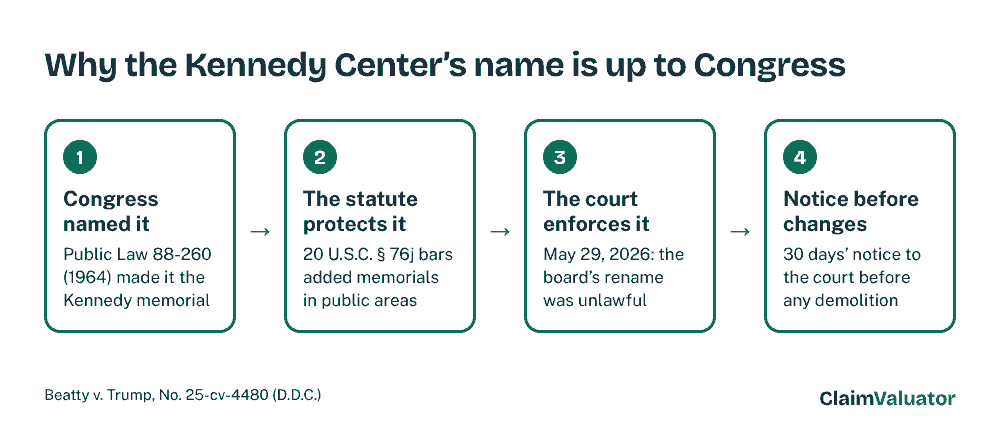
Most of the case turns on a short federal statute. In 1964, two months after President Kennedy’s assassination, Congress renamed the planned National Cultural Center the John F. Kennedy Center for the Performing Arts (Public Law 88-260). The building opened in 1971. Four provisions of that law matter here:
- It is a memorial by law. The board must maintain and administer the Center “as the National Center for the Performing Arts, a living memorial to John Fitzgerald Kennedy” (20 U.S.C. § 76h(a)(1)).
- Congress set the name. Section 76i designates the institution as the John F. Kennedy Center for the Performing Arts, and lets the board acknowledge private contributions only “in the interior” of the project, Beatty’s lawyers point out (Beatty’s August 2026 brief).
- No new memorials. The board must ensure that “no additional memorials or plaques in the nature of memorials shall be designated or installed in the public areas” of the Center (20 U.S.C. § 76j(b)(1)).
- Narrow exceptions. The ban does not cover plaques for gifts from foreign countries, plaques on donated theater chairs or boxes, or certain gallery inscriptions acknowledging a major contribution, as long as board policy permitted them on December 2, 1983.
The statute also makes the House and Senate leaders and several other members of Congress members of the board. That is why Beatty, a Democratic House member, sits on it and could bring the suit.
Ruling one: the Trump name has to come off (May 29, 2026)
In a 94-page decision, Judge Cooper held that the Center’s founding statute makes its name “crystal clear” and that the board cannot add another formal name or memorial on its own. Congress gave the Center its name, he wrote, and only Congress can change it. He gave the Center 14 days to stop using “Trump Kennedy Center” and similar names on signs and online, restored Beatty’s voting rights on the board, and temporarily blocked the two-year closure, calling the plan “murky” and finding the board had too little information when it voted (NPR).
The Kennedy Center’s spokesperson said it would appeal, noting that the building needs major restoration and that $257 million secured by Trump and approved by Congress was in place. Trump attacked the judge on Truth Social. Beatty said the Center “belongs to the American people, not to Donald Trump.”
On July 8, a D.C. Circuit panel of Judges Gregory Katsas, Patricia Millett and Robert Wilkins refused to pause the ruling while the appeal goes forward. The administration had argued that removing the name would hurt fundraising, but the court said it “failed to support this assertion with any specific facts or evidence” (Denver Gazette).
Ruling two: no inscriptions and no “Trump Plaza” (September 15, 2026)
In August, the board tried a different route. Its “recognition resolution” would have added three things:
- An inscription beneath the Center’s name: “Restored and Renovated by President Donald J. Trump”
- A second line, “Endowed by The Trump Kennedy Center Fund,” once the fund reached $100 million
- A new name for the surrounding grounds: “President Donald J. Trump Plaza”
Beatty asked for emergency relief, arguing that the plan was a renaming in another form and an unlawful memorial under section 76j, that exterior donor recognition is barred, and that the trustees were breaching their fiduciary duties (Beatty’s brief). The Justice Department answered that “an order blocking the Board from appropriately recognizing President Trump will cause donors to flee.”
Cooper sided with Beatty. The board “cannot install memorials for President Donald J. Trump, or anyone else who is not former President John F. Kennedy,” without Congress (JURIST). He also required notice before any future Trump-related inscription or acknowledgment.
The closure and the demolition threat
The idea of tearing the building down first appeared in court papers. In an August 25 filing, Justice Department lawyer Brantley Mayers called the Center “decrepit” and in an imminent “death spiral,” and said that without the administration’s plan it “will be required to be taken down.” The filing floated a cheaper replacement, an outdoor amphitheater overlooking the Potomac, while conceding it would “fail to adequately honor” Kennedy (ABC News, The Star).
The threat grew after the September ruling. The board voted on September 15 to close the main building, and Trump said repairs would happen only if the board could add his name. The next day, executive director Matt Floca shut the building without notice, citing “acute risks to public safety resulting from continued structural deterioration.” Trump said that without his plan, “it’s going to close. It’ll end up being ripped down,” adding, “It’s in very, very bad shape, very dangerous shape” (AP).
Beatty’s lawyers called the closure a “plain pretext to justify shutting down the Center permanently.” Cooper did not hold an emergency hearing, but on September 17 he ordered the Center to give 30 days’ notice before any major physical change, including demolition, to “avoid any confusion on that score given more recent events” (AP). Protesters formed a human chain around the building the next day.
The building’s problems are real. Engineers from Walter P Moore found significant corrosion and water damage on most of the exterior soffit panels, each weighing more than 2,000 pounds and hanging 60 feet above areas the public uses, and called for “immediate” repairs because of a falling object hazard (NBC Washington). In an interview with TIME, Trump declined to promise he would not demolish the building without Congress: “I’m not committing to anything” (ABC News).
Can a president tear down the Kennedy Center?
No court has ruled on whether demolition would be lawful, and no formal demolition plan has been filed. The legal framework looks like this:
- The statute assigns a duty to maintain. The board must maintain and administer the Center as a living memorial to Kennedy. Critics argue demolition cannot be squared with that duty without new legislation. The administration argues the building’s condition leaves no responsible alternative if its plan is blocked.
- Congress holds the money. The roughly $257 million for repairs came from Congress, and Congress controls any future appropriation for a replacement.
- The court has set a tripwire. The 30-day notice order gives Beatty time to seek emergency relief before any major physical work begins.
- Congress can change the rules. Lawmakers could rename the Center, authorize the Trump recognition, or pass the Kennedy Center Protection Act. None of those has happened.
What each side argues
The administration and the board say the building is in crisis and only this administration can save it. Its filings call the Center “structurally unsound, fundamentally unsafe, and embarrassing to the nation’s capital” and say “the crisis is so acute that, without the Trump Administration, its people, and President Trump, the Center cannot survive.” They say donors expect recognition, that the plaintiff herself acknowledges the building needs major restoration, and that the closure is about safety, not the naming fight.
Beatty and her allies say Congress named the Center for Kennedy alone and barred new memorials, that the inscriptions are a renaming by another route, and that the closure is a pressure tactic. They point to the construction documents the board relied on: a five-slide presentation that, her lawyers say, did not “identify even a single benefit to remaining partially open while renovating,” and a 163-page plan with no cost-benefit analysis of closure (Newsweek). Sen. Mark Warner and Rep. Chellie Pingree have criticized the closure; Pingree said, “Closing the Kennedy Center was never about renovation.”
What happens next
- Appeals. The D.C. Circuit will decide the administration’s appeal. Until an appeals court says otherwise, the district court’s orders stand.
- Weekly updates. Cooper has asked for weekly reports on repairs and the closure. Floca says the closure is reconsidered week by week.
- Document fights. Cooper ordered the board’s construction presentation released and the larger plan made public with narrow redactions. A separate dispute over the administration’s executive privilege claim continues.
- Programming. No shows are scheduled in the main building’s theaters. The Kennedy Center Honors moved to Capital One Arena on October 2.
- Congress. After the November 3 election, the lame-duck Congress and then the new Congress in January could legislate on the name or the building.
Frequently asked questions
Is the Kennedy Center closed?
Yes. The main building has been closed since mid-September 2026, while engineers assess safety. There is no reopening date. Free events continue in The REACH, a separate building on the campus.
Did a judge block Trump’s name on the Kennedy Center?
Yes, twice. On May 29, 2026, Judge Christopher Cooper ordered the “Trump Kennedy Center” name removed. On September 15, 2026, he blocked new inscriptions honoring Trump and the renaming of the grounds as “President Donald J. Trump Plaza.”
Can the Kennedy Center be renamed?
Only by Congress, according to the court. The 1964 law that named the Center for Kennedy also makes it a living memorial to him and bars new memorials in its public areas.
Is Trump going to demolish the Kennedy Center?
No demolition has been proposed in court. A Justice Department filing said the building may have to be taken down if the administration’s plan is blocked, and Trump said it could be “ripped down.” The court requires 30 days’ notice before any major physical change.
Who sued over the Kennedy Center name?
Rep. Joyce Beatty (D-Ohio), who sits on the Kennedy Center board because of her seat in Congress. The case is Beatty v. Trump, No. 25-cv-4480, in federal court in Washington.
How much will the Kennedy Center renovation cost?
Congress provided about $257 million for repairs. The board’s plan would close the main building for about two years.
Where were the 2026 Kennedy Center Honors held?
At Capital One Arena in Washington on October 2, 2026, because of the dispute and the closure.
Sources
- NPR via WUNC: Trump’s name must come off the Kennedy Center, judge rules (May 29, 2026)
- Denver Gazette: Appeals court declines to restore Trump’s name (July 8, 2026)
- ABC News: Administration suggests the Kennedy Center could be demolished (Aug. 25, 2026)
- AFP via The Star: Trump raises prospect of demolishing the Kennedy Center (Aug. 26, 2026)
- JURIST: Judge blocks latest attempt to add Trump’s name (Sept. 17, 2026)
- The Hill: Judge blocks new Trump inscription on Kennedy Center
- TIME: Kennedy Center board approves immediate building closure (Sept. 15, 2026)
- Associated Press via KY3: 30 days’ notice before major physical changes (Sept. 17, 2026)
- ABC News: Internal email points to continued closure (Oct. 1, 2026)
- NBC Washington: Kennedy Center to remain closed as safety assessments continue (Oct. 1, 2026)
- Newsweek: Kennedy Center construction plans revealed (Oct. 8, 2026)
- Al Jazeera: Board votes to rename the Kennedy Center (Dec. 18, 2025)
- Beatty v. Trump, memorandum in support of emergency relief (Aug. 20, 2026, via CourtListener)
- 20 U.S.C. § 76h (Cornell LII)
- 20 U.S.C. § 76j (Cornell LII)
- GovInfo: H.R. 6925, Kennedy Center Protection Act
This article reports court records and published reporting on pending litigation. It is not legal advice.