Key points
- Talc is a natural mineral, a hydrous magnesium silicate. The main safety concerns are asbestos contamination, because talc and asbestos can form near each other, and a possible link between genital use of talc powder and ovarian cancer.
- The evidence on ovarian cancer is mixed. A 2020 pooled study of 252,745 women found no statistically significant link, while a 2024 NIH study found a consistent association, and the WHO’s cancer agency classified talc as “probably carcinogenic” in July 2024.
- FDA says studies have not conclusively shown a link to ovarian cancer. In November 2025 it withdrew a proposed rule that would have required standard asbestos testing of talc cosmetics.
- In July 2026 Johnson & Johnson agreed to a $5.5 billion settlement of ovarian cancer talc lawsuits. It is not final until about 95% of claimants accept it, and it does not cover mesothelioma claims.
- Talc lawyers generally work on contingency. Deadlines depend on your state and often run from when you learned your cancer may be linked to talc.
Talcum powder has been sold for generations to absorb moisture and reduce friction. Since the 2010s, it has also been at the center of one of the largest product liability fights in the United States, with tens of thousands of people claiming talc products caused their ovarian cancer or mesothelioma.
This guide explains what talcum powder is made of, what regulators and researchers say about its safety for adults, where the Johnson & Johnson talc lawsuits stand in 2026, and who may qualify to file a claim.
What is talcum powder made of?
Talc is “a naturally occurring mineral, mined from the earth, composed of magnesium, silicon, oxygen, and hydrogen,” according to the U.S. Food and Drug Administration. Chemically, it is a hydrous magnesium silicate (FDA). It is used in body and baby powders, makeup, eye shadow and many other cosmetics because it absorbs moisture and helps products spread.
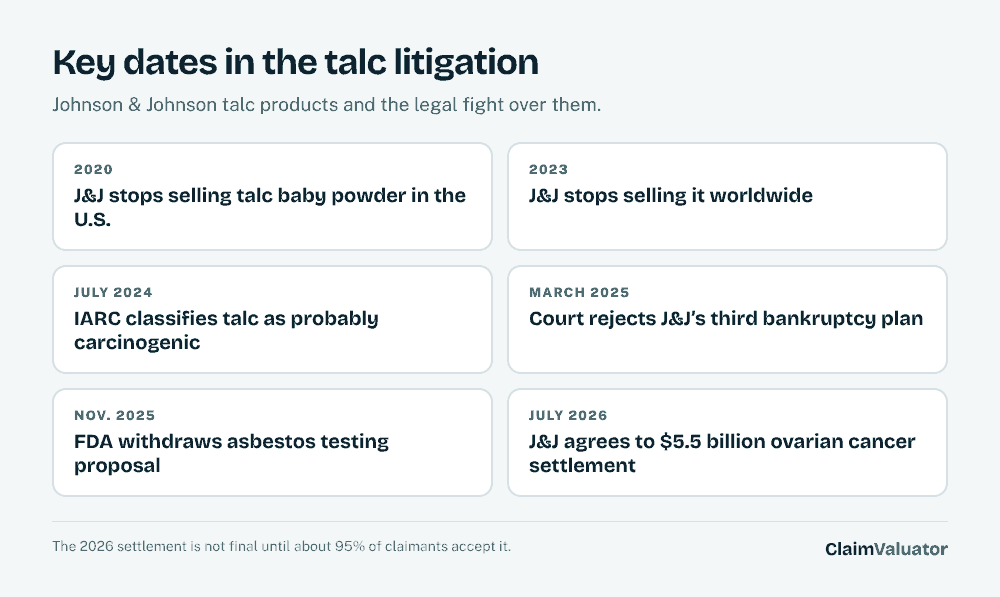
Many powders now use cornstarch instead of talc. Johnson & Johnson stopped selling talc-based baby powder in the United States in 2020 and worldwide in 2023 (Al Jazeera).
Is talcum powder safe for adults?
There are two separate concerns, and they are often confused.
1. Asbestos contamination
Talc and asbestos can occur close together in the earth, so talc can be contaminated with asbestos if mining sites are not chosen carefully and the ore is not tested well enough. Unlike talc, asbestos is a known carcinogen when inhaled (FDA). Asbestos exposure is the main cause of mesothelioma, which is why many talc lawsuits involve that cancer.
A 2022 federal law directed FDA to set standard testing methods for asbestos in talc cosmetics. FDA proposed a rule in December 2024 but withdrew it on November 28, 2025, citing public comments and the complexity of asbestos testing, and said it plans to issue a new proposal (Perkins Coie summary). For now, FDA says it does not have recommendations on standards or testing methods for asbestos in talc.
2. Ovarian cancer and genital use
The second concern is whether applying talc powder to the genital area can raise the risk of ovarian cancer, even when the talc is not contaminated with asbestos. The research does not point clearly in one direction:
- A 2020 pooled analysis of 252,745 women in four U.S. studies found “not a statistically significant association” between genital powder use and ovarian cancer, with a hazard ratio of 1.08 (95% CI 0.99 to 1.17). The authors noted the study may have been too small to detect a slight increase in risk (O’Brien et al., JAMA 2020).
- A 2024 analysis of the NIH Sister Study, published in the Journal of Clinical Oncology, reported “a consistent association between genital talc use and ovarian cancer” after testing for recall bias (NIEHS).
- In July 2024, the International Agency for Research on Cancer, part of the World Health Organization, classified talc as “probably carcinogenic to humans” (Group 2A) (IARC). IARC classifications describe how strong the evidence of a cancer hazard is, not how large the risk is at everyday exposure levels.
- FDA’s position is that studies since the 1960s have suggested a possible link but “have not conclusively demonstrated such a link” (FDA).
If you are worried, practical steps include not using talc powder in the genital area, avoiding breathing in powder dust, and choosing talc-free products. Talk to your doctor about your own cancer risk, especially if you have a family history of ovarian cancer.
Talc lawsuits explained
Most talc lawsuits are against Johnson & Johnson and its former talc unit, over Johnson’s Baby Powder and Shower to Shower. The claims fall into two groups: ovarian cancer claims, which argue genital use of talc caused the disease, and mesothelioma claims, which argue the talc was contaminated with asbestos. J&J maintains that its talc is safe and does not cause cancer.
Federal ovarian cancer cases are consolidated in multidistrict litigation in New Jersey (MDL 2738), before Judge Michael Shipp, which had about 68,435 pending cases in July 2026 (MDL Update). Other cases are in state courts.
Three bankruptcy attempts
J&J tried three times to resolve the ovarian cancer claims through the bankruptcy of a subsidiary. On March 31, 2025, U.S. Bankruptcy Judge Christopher Lopez in Houston rejected the third attempt, a roughly $9 billion plan through a unit called Red River Talc. J&J said it would not appeal and would return to fighting the cases in court (NJBIZ).
The 2026 ovarian cancer settlement
On July 27, 2026, J&J announced a $5.5 billion agreement to settle about 69,000 ovarian cancer cases in federal and state courts. The deal becomes final only if about 95% of claimants accept it (Al Jazeera). According to case trackers, the first payment would be no more than $3 billion in 2027, payments are made per claim rather than from a fixed fund, and mesothelioma claims are not included; J&J says it has already settled about 95% of filed mesothelioma lawsuits (MDL Update). Eligibility criteria and individual amounts have not been published, so claimants should rely on their own lawyers for details.
Who may qualify for a talc lawsuit?
- People diagnosed with ovarian cancer, and in some cases fallopian tube or primary peritoneal cancer, who regularly used talc powder in the genital area for years.
- People diagnosed with mesothelioma who regularly used talc products, especially where testing or records suggest asbestos contamination.
- Families of people who died from these cancers, through a wrongful death claim. See our wrongful death settlement calculator.
Evidence that matters includes medical records and pathology reports, a history of which products you used, for how long and how often, and any receipts, containers or photos. Mesothelioma claims also involve other possible asbestos exposures, which our asbestos and mesothelioma claims guide explains.
How much is a talc claim worth?
There is no reliable public “average” talc settlement. Individual payments under the 2026 ovarian cancer deal have not been published, and jury verdicts have ranged from defense wins to large awards that are often reduced or appealed. What generally affects value:
- The diagnosis, its stage and the treatment required.
- How long and how often you used talc products, and how well that is documented.
- Medical evidence connecting your cancer to talc, and other risk factors such as genetics.
- Age, earnings and family situation, and whether the claim is a wrongful death claim.
- Where the case is pending, and for MDL cases, any common benefit fees and liens.
Deadlines and choosing a talc lawyer
Each state sets its own statute of limitations for product liability claims, and many run from when you knew or should have known that talc may have caused your illness. Check the general rule in your state with our statute of limitations calculator, and talk to a lawyer promptly. Settlement programs also set their own participation deadlines.
Talc lawyers generally work on contingency. Ask whether the firm has cases in MDL 2738 or the relevant state court, how the 2026 settlement would apply to your claim, the fee percentage, and how costs, common benefit fees and medical liens are handled. Our guide on how to choose a personal injury lawyer lists more questions to ask, and the attorney fee calculator shows how fees affect your share.
Frequently asked questions
Is talcum powder safe for adults?
Regulators have not concluded that talc itself causes cancer, but there are two concerns: possible asbestos contamination, and mixed evidence linking genital use to ovarian cancer. Many people choose talc-free products to avoid both.
What is talcum powder made of?
Talc is a natural mineral made of magnesium, silicon, oxygen and hydrogen, a hydrous magnesium silicate. Powders may also contain fragrance and other ingredients.
Does talcum powder cause ovarian cancer?
The evidence is mixed. Some large studies found no significant link and others found an association. IARC classified talc as probably carcinogenic in 2024, while FDA says a link has not been conclusively shown.
Is the J&J talc settlement final?
Not yet, as of October 2026. The $5.5 billion ovarian cancer deal announced in July 2026 needs about 95% of claimants to accept it.
Does the talc settlement cover mesothelioma?
No. The 2026 settlement covers ovarian cancer claims. Mesothelioma claims are handled separately.
Can I still file a talc lawsuit?
Possibly, depending on your diagnosis, your talc use and your state’s deadline. Talk to a lawyer about whether a new claim would be included in any settlement.
Is cornstarch powder safer than talc?
Cornstarch powders do not carry the asbestos contamination concern that talc does. Ask your doctor before using any powder in the genital area.
Sources
- U.S. Food and Drug Administration: Talc
- Perkins Coie: FDA withdraws proposed rule on asbestos testing in talc cosmetics (Nov. 2025)
- IARC: Monographs evaluate the carcinogenicity of talc (July 2024)
- O’Brien et al., Association of Powder Use in the Genital Area With Risk of Ovarian Cancer, JAMA (2020)
- NIEHS: Genital talc use and ovarian cancer, Sister Study analysis (2024)
- NJBIZ: Judge rejects J&J’s third attempt to resolve talc suits via bankruptcy (March 2025)
- Al Jazeera: J&J reaches $5.5 billion settlement over talc ovarian cancer lawsuits (July 2026)
- MDL Update: J&J talc settlement details (July 2026)
This article is general information, not legal or medical advice. Talk to your doctor about health concerns and to a licensed attorney about a possible claim.