Key points
- Most personal injury lawyers work on contingency: no fee unless they recover money, usually about one-third of a settlement and often 40% once a lawsuit is filed.
- The fee agreement must be in writing and signed by you, and it must say whether case costs come out before or after the lawyer’s percentage (ABA Model Rule 1.5(c)).
- Pick a lawyer who handles your type of injury, has trial experience, and will personally work on your file. Check their license and discipline history with the state bar.
- You can fire your lawyer and hire another. You normally do not pay two full fees; the first lawyer is paid from the second lawyer’s fee or for the work already done.
- A lawyer is worth the most when injuries are serious, fault is disputed, or the at-fault party’s insurance may not cover your losses.
Choosing a personal injury lawyer is one of the few decisions in an injury claim that is fully in your control. The right lawyer can change how an insurer values your claim. The wrong one can leave you waiting months for calls to be returned. Ads with phrases like “best personal injury lawyer” tell you very little, because almost every firm uses them.
This guide explains when you actually need an injury lawyer, how contingency fees work, what to check before you sign, the questions to ask in a free consultation, the red flags to walk away from, and what happens if you want to switch lawyers later.
Do you need a personal injury lawyer?
Not every injury claim needs a lawyer. A minor injury with clear fault, short treatment and small medical bills can often be settled directly with the insurer. You can test a first offer with our settlement offer calculator before deciding.
A lawyer usually adds the most value when:
- Your injuries are serious or long-lasting, such as fractures, surgery, a brain injury or permanent scarring.
- The other side disputes fault, or you may share some of the blame (see our comparative fault calculator).
- The at-fault party’s policy limits may be too low to cover your losses.
- The defendant is a business, a trucking company, a property owner or a government agency, which often brings shorter notice deadlines.
- You missed work for a long time, or your future earnings are affected.
- An adjuster is pushing for a recorded statement, a quick release or access to your full medical history.
Representation is now common. The Insurance Research Council, an insurer-funded research group, found that the share of auto injury claimants with a lawyer rose from 40% in 2017 to nearly 50% in 2022 (IRC, July 2026). The same study found that represented bodily injury claims took a median of nearly 440 days to close, more than double the time for unrepresented claims. After medical bills and legal fees, represented claimants kept $1.40 per dollar of medical bills, compared with $1.80 for people without a lawyer.
Read those numbers with care. Represented claims tend to involve more serious injuries, disputed fault and litigation, so the two groups are not directly comparable. The fair takeaway is that a lawyer is not automatically worth it for a small, simple claim, and is usually worth it when the stakes and the obstacles are high.
How personal injury lawyers get paid
Almost all injury lawyers work on a contingency fee. You pay nothing up front. The lawyer takes an agreed percentage of whatever is recovered, and nothing if there is no recovery. A common structure is about 33% if the case settles before a lawsuit is filed and 40% if it goes into litigation, but percentages are negotiable and vary by state and firm.
What the written fee agreement must say
Under ABA Model Rule 1.5(c), which most states follow in some form, a contingent fee agreement must:
- Be in writing and signed by the client.
- State the percentage or percentages the lawyer gets if the case settles, goes to trial or is appealed.
- List the litigation expenses that will be deducted, and say whether they are deducted before or after the percentage is calculated.
- Disclose any expenses you must pay even if you win.
At the end of the case, the lawyer must give you a written closing statement showing the recovery, the fee, the expenses and how your share was calculated.
Costs before or after the fee: a worked example
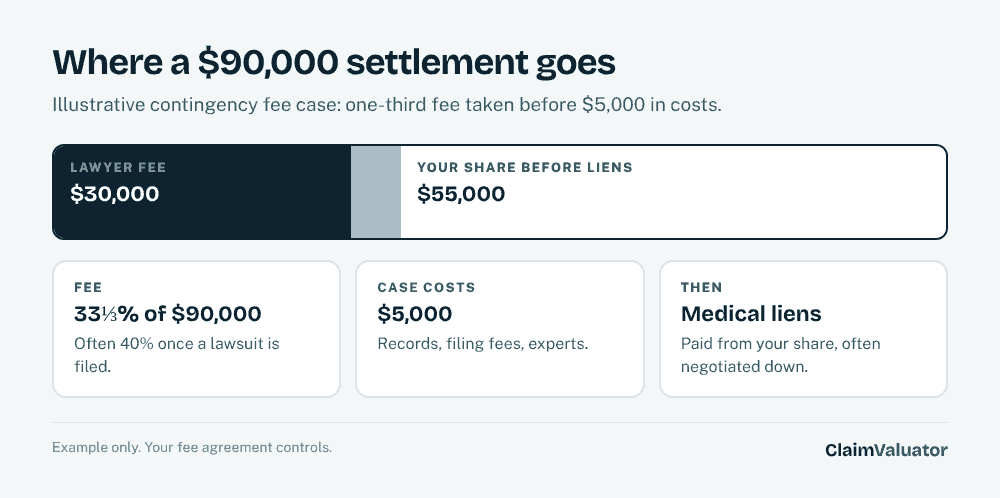
Case costs, such as filing fees, medical records, expert witnesses and depositions, are separate from the fee. Whether they come off before or after the lawyer’s percentage changes what you take home. Here is a $90,000 settlement with $5,000 in costs and a one-third fee:
| Fee taken before costs | Fee taken after costs | |
|---|---|---|
| Gross settlement | $90,000 | $90,000 |
| Case costs | $5,000 | $5,000 |
| Lawyer’s fee (33⅓%) | $30,000 (of $90,000) | $28,333 (of $85,000) |
| Your share before medical liens | $55,000 | $56,667 |
Your share can drop further if health insurers, Medicare or hospitals have liens on the settlement. Our attorney fee and net payout calculator runs these numbers for you, and our guide to medical liens explains how they are reduced.
Some states and claims cap the fee
A few rules limit how much an injury lawyer may charge:
- Federal claims. For claims against the U.S. government under the Federal Tort Claims Act, fees are capped at 20% of an administrative settlement and 25% of a judgment or settlement after suit (28 U.S.C. § 2678).
- Florida. The Florida Bar’s Rule 4-1.5(f)(4)(B) presumes a fee is excessive above 33⅓% of the first $1 million if the case resolves before the defendant answers, and above 40% of the first $1 million after that, with lower percentages for larger recoveries. Florida clients must also receive a signed statement of client’s rights (Rules Regulating The Florida Bar).
- Medical malpractice. Several states use sliding scales for malpractice fees. Ask any lawyer which limits apply to your case.
How to choose a personal injury lawyer: 9 things to check
- Focus. Look for a lawyer who handles your type of case every week: car crashes, trucking, medical malpractice, product liability or premises cases are different specialties.
- Trial experience. Very few injury cases reach a verdict. Federal data on state courts found that only about 3% of tort cases were resolved by trial (Bureau of Justice Statistics). Insurers still track which lawyers will go to trial, and they price settlements accordingly. Ask how many cases the lawyer has tried.
- A clean license. Search the lawyer on your state bar’s website to confirm they are licensed and to see any public discipline.
- Who does the work. At high-volume firms, the lawyer you meet may hand your file to a case manager. Ask who will negotiate with the adjuster and who will appear in court.
- Communication. Ask how often you will get updates and how quickly calls are returned. Slow communication is the most common complaint clients have about their lawyers.
- Clear fees. Get the percentage, the cost policy and any referral arrangement in writing before you sign.
- Resources. Serious cases need experts and medical testimony. Ask whether the firm can fund those costs while the case is pending.
- Local knowledge. A lawyer who regularly appears in the county where your case would be filed knows the judges, juries and local defense firms.
- Certification (optional). Some lawyers are board certified in civil trial advocacy by organizations such as the National Board of Trial Advocacy. It is a useful signal, not a requirement.
You can find candidates through your state bar’s lawyer referral service, recommendations from people you trust, and our Find an Expert directory. Meet two or three lawyers before you decide. Consultations are almost always free.
Questions to ask in the free consultation
- How many cases like mine have you handled in the past two years?
- What do you think my case is worth, and what could make it worth more or less?
- Who will handle my case day to day?
- What percentage do you charge before and after a lawsuit is filed?
- Are costs deducted before or after your fee, and do I owe anything if we lose?
- How do you handle medical liens and unpaid bills while the case is open?
- How long do you expect my case to take?
- How often will you update me, and how?
- Have you taken cases like this to trial?
- Is there anything that worries you about my case?
Bring the accident report, photos, medical records, insurance letters and any settlement offer. If you already have an offer, our guide on whether to accept the first settlement offer explains how to judge it.
Red flags: when to walk away
- Someone contacts you first. ABA Model Rule 7.3 bars lawyers from soliciting clients through live person-to-person contact for money. A stranger who shows up at the hospital or calls right after a crash offering a lawyer is a warning sign.
- Guaranteed results. No honest lawyer can promise a specific amount at the first meeting.
- Pressure to sign immediately. You should be able to take the agreement home and read it.
- Vague costs. If the lawyer cannot explain how costs are handled, expect surprises at the end.
- Undisclosed referrals. If your case is being referred to another firm, Rule 1.5(e) requires that you agree in writing to the split, and the total fee must still be reasonable.
- No time for you. If you cannot get the lawyer on the phone before signing, it will not get easier later.
Can you switch personal injury lawyers?
Yes. Under the ABA Model Rules, a client can discharge a lawyer at any time, with or without cause, and the lawyer must withdraw and hand over the file. You stay responsible for the reasonable value of the work already done, but in contingency cases that is usually paid out of the final fee. The first and second lawyers typically divide one fee, either by agreement or by a court deciding what each earned. Ask the new lawyer to explain how the previous lawyer’s lien will be handled before you switch.
How long does a personal injury case take?
Simple claims can settle in a few months. Represented auto injury claims took a median of almost 440 days to close in the Insurance Research Council’s study. Cases that go to litigation often take one to three years. Our guide to how long a settlement takes breaks down each stage.
Whatever you decide, do not wait too long to talk to a lawyer. Every state has a statute of limitations for injury lawsuits, and claims against government agencies can require written notice within months.
Frequently asked questions
How much does a personal injury lawyer charge?
Most charge a contingency fee of about 33% of a settlement reached before a lawsuit and around 40% if the case is litigated, plus case costs. You pay nothing if there is no recovery, unless your agreement says otherwise for certain costs.
Is 40% normal for a personal injury lawyer?
It is common once a lawsuit is filed or a case goes to trial, because the work and risk increase. Some states cap fees, and many lawyers will negotiate, especially for strong cases or large expected recoveries.
Do I pay my lawyer if we lose?
Not the fee. Whether you owe case costs after a loss depends on your written agreement, which must disclose any expenses you would still owe.
Can I negotiate a lawyer’s percentage?
Yes. Fees are not set by law in most cases. You can ask for a lower percentage, a sliding scale, or costs deducted before the fee is calculated.
Should I hire the lawyer I see on TV?
Advertising budget says nothing about results. Judge any lawyer on experience with your type of case, who will actually handle your file, communication and the written fee terms.
Is a free consultation really free?
Yes. Injury lawyers almost always offer free consultations and you are not obligated to hire them. Use it to compare at least two lawyers.
Can I settle without a lawyer?
Yes, many small claims are settled directly with insurers. Read our guide to how injury settlements are calculated and estimate your claim with the personal injury settlement calculator first.
Sources
- American Bar Association: Model Rule 1.5, Fees
- American Bar Association: Model Rule 1.16, Declining or Terminating Representation
- American Bar Association: Model Rule 7.3, Solicitation of Clients
- Insurance Research Council: Auto Injury Insurance Claims, A Study of Increasing Claim Severity (July 2026)
- Bureau of Justice Statistics: Civil Bench and Jury Trials in State Courts, 2005
- 28 U.S.C. § 2678, attorney fee limits under the Federal Tort Claims Act
- Rules Regulating The Florida Bar, Rule 4-1.5
This article is general information, not legal advice. Fee rules and deadlines vary by state. Talk to a licensed attorney in your state about your situation.