Key points
- Nursing home abuse includes physical, sexual, emotional and financial abuse, and neglect such as untreated bedsores, dehydration, falls and overmedication.
- Federal rules give every resident the right to be free from abuse and neglect, and require nursing homes to report suspected abuse to the state within 2 hours when it involves abuse or serious bodily injury (42 CFR 483.12).
- If you suspect abuse, get the resident safe, document everything, and report it to the facility, the state survey agency and the long-term care ombudsman.
- A nursing home cannot make you sign an arbitration agreement as a condition of admission, and you have 30 days to cancel one you signed.
- Nursing home abuse lawyers work on contingency. Deadlines can be short, especially when a resident has died.
Families choose a nursing home because they need people they can trust. The evidence shows that trust is sometimes broken. The World Health Organization reports that in institutions such as nursing homes and long-term care facilities, 2 in 3 staff reported in surveys that they had committed some form of abuse in the past year (WHO fact sheet, June 2024). In the United States, the Government Accountability Office found that abuse deficiencies cited in nursing homes more than doubled, from 430 in 2013 to 875 in 2017 (GAO-19-433).
This guide explains the warning signs, the legal rights every resident has, what to do if you suspect abuse, how nursing home claims work and how to choose a nursing home abuse lawyer.
Types of nursing home abuse and neglect
| Type | What it looks like | Warning signs |
|---|---|---|
| Neglect | Failure to provide food, water, hygiene, repositioning, supervision or medical care | Bedsores (pressure injuries), dehydration, weight loss, poor hygiene, repeated falls, untreated infections |
| Physical abuse | Hitting, pushing, rough handling or improper restraints | Unexplained bruises, fractures, cuts, restraint marks, injuries staff cannot explain |
| Emotional abuse | Yelling, threats, humiliation or isolation | Fear of certain staff, withdrawal, agitation, sudden changes in mood |
| Sexual abuse | Any non-consensual sexual contact | Bruising in private areas, new infections, distress during personal care |
| Financial exploitation | Theft, misuse of funds, pressure to change wills or accounts | Missing money or belongings, unusual withdrawals, new names on accounts |
| Chemical restraint | Using sedatives or antipsychotics to control behavior for staff convenience | Sudden drowsiness, confusion, falls after a medication change |
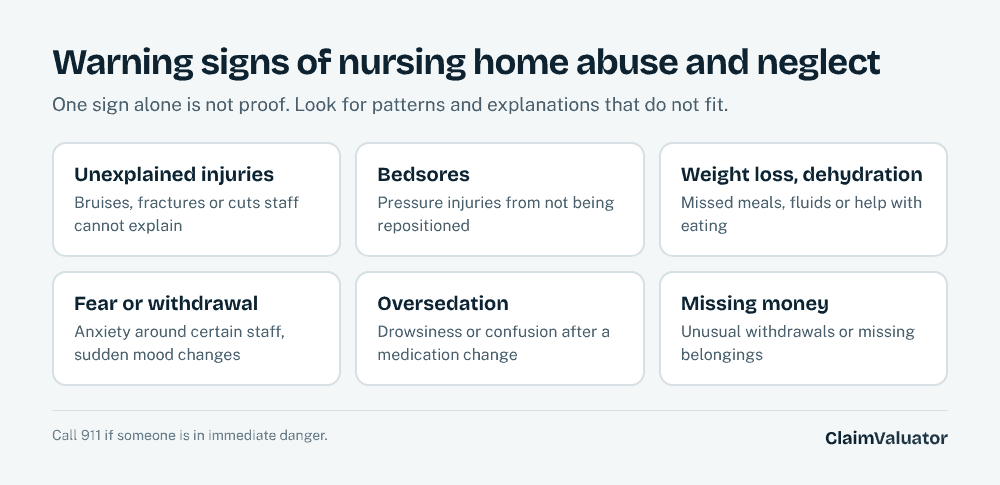
One sign alone does not prove abuse. Older residents bruise easily and fall for many reasons. What matters is a pattern, explanations that do not fit the injury, or a facility that will not give you straight answers.
Your rights under federal law
Nursing homes that take Medicare or Medicaid must follow federal resident rights rules. Under 42 CFR 483.12:
- Every resident has the right to be free from abuse, neglect, misappropriation of property and exploitation.
- The facility must not use verbal, mental, sexual or physical abuse, corporal punishment or involuntary seclusion.
- Physical or chemical restraints may not be used for discipline or staff convenience, only to treat a medical symptom, and then in the least restrictive way for the shortest time.
- Suspected abuse, neglect or exploitation must be reported to the administrator and the State Survey Agency immediately: within 2 hours if the allegation involves abuse or serious bodily injury, and within 24 hours otherwise.
- The facility must investigate and send the results to the State Survey Agency within 5 working days.
States add their own residents’ rights laws, and many have elder abuse statutes that allow extra damages or attorney’s fees.
What to do if you suspect nursing home abuse
- Make the resident safe. If there is immediate danger or a serious injury, call 911.
- Get a medical evaluation. Ask the resident’s doctor or an emergency room to examine and document injuries.
- Document everything. Take dated photos, write down what you saw and who you spoke to, and keep copies of care plans, medication lists and bills.
- Report it to the facility in writing. Address it to the administrator and the director of nursing, and keep a copy.
- Report it outside the facility. Contact your state survey agency (the state department that licenses nursing homes), your local long-term care ombudsman and Adult Protective Services. The Eldercare Locator can direct you to local offices.
- Check the facility’s record. Medicare’s Care Compare tool shows inspection results, staffing levels and penalties.
- Request records. Residents and their legal representatives can ask for the resident’s medical records. Do this early, before anything is lost.
- Talk to a lawyer before signing anything the facility or its insurer sends you.
Arbitration agreements in nursing home contracts
Many admission packets include a binding arbitration agreement that would move any dispute out of court. Under a 2019 federal rule for long-term care facilities, a nursing home cannot require you to sign one as a condition of admission or continued care. The agreement must say so plainly, must be explained in a way you understand, and must let you cancel it within 30 calendar days of signing (summary of the CMS rule). If you signed one, a lawyer can review whether it was valid and whether it applies to your claim.
How nursing home abuse claims work
Most claims are based on negligence: the facility failed to provide reasonable care and the resident was harmed. Depending on the state and the facts, a claim may also involve violations of residents’ rights laws, elder abuse statutes, medical malpractice rules or wrongful death.
Who can file
- The resident, if able, or a legal representative such as an agent under a power of attorney or a court-appointed guardian.
- The resident’s estate, if the resident has died, and family members through a wrongful death claim.
What compensation may cover
- Medical treatment for injuries caused by the abuse or neglect, including hospital stays and wound care.
- Pain and suffering and emotional distress (see our pain and suffering calculator).
- Money taken through financial exploitation.
- Funeral costs and loss of companionship in wrongful death cases.
- Punitive damages in some states for reckless or intentional misconduct.
Some states cap damages in claims treated as medical malpractice, and Medicare or Medicaid may have a lien on any recovery. Our guide to medical liens explains how those are handled.
Deadlines
Each state sets its own statute of limitations, and claims treated as medical malpractice can have shorter limits and pre-suit requirements such as expert affidavits. Wrongful death deadlines usually run from the date of death. Check the general rule in your state with our statute of limitations calculator and talk to a lawyer promptly.
How to choose a nursing home abuse lawyer
- Look for a lawyer who regularly handles nursing home and elder abuse cases, not just general injury claims.
- Ask how they obtain facility records, staffing data and inspection reports, and whether they work with nursing and geriatric experts.
- Ask how they handle arbitration agreements and Medicare or Medicaid liens.
- Confirm the contingency percentage and how costs are handled, in writing.
- Check the lawyer’s license and discipline history with your state bar.
Our guide on how to choose a personal injury lawyer lists the questions to ask in a free consultation. You can also search our Find an Expert directory.
Frequently asked questions
How do I report nursing home abuse?
Call 911 for emergencies. Otherwise report it in writing to the facility administrator, and to your state survey agency, the long-term care ombudsman and Adult Protective Services.
What are the most common signs of nursing home neglect?
Bedsores, dehydration, sudden weight loss, poor hygiene, repeated falls and untreated infections are among the most common signs.
How quickly must a nursing home report suspected abuse?
Under federal rules, within 2 hours if the allegation involves abuse or serious bodily injury, and within 24 hours otherwise, with investigation results due to the state within 5 working days.
Can I sue a nursing home if I signed an arbitration agreement?
Possibly. The agreement cannot be required for admission and can be cancelled within 30 days. A lawyer can check whether it is valid and covers your claim.
How much does a nursing home abuse lawyer cost?
Most work on contingency, taking a percentage of any recovery, so there is nothing to pay up front.
Can family members file a claim?
A legal representative can file for a living resident, and the estate or certain family members can file a wrongful death claim if the resident died.
How do I check a nursing home’s inspection history?
Use Medicare’s Care Compare website, which shows inspection findings, staffing and penalties for each certified facility.
Sources
- World Health Organization: Abuse of older people, fact sheet (June 15, 2024)
- U.S. Government Accountability Office: Nursing Homes, Improved Oversight Needed to Better Protect Residents from Abuse (GAO-19-433)
- 42 CFR 483.12: Freedom from abuse, neglect and exploitation
- National Law Review: CMS final rule on arbitration agreements in long-term care facilities (2019)
- Medicare Care Compare
- Administration for Community Living: Long-Term Care Ombudsman Program
This article is general information, not legal or medical advice. If someone is in immediate danger, call 911. Laws and deadlines vary by state; talk to a licensed attorney about your situation.