Key points
- For a commercial driver, a traffic ticket can cost a career. Two serious violations within three years mean a 60-day CDL disqualification, and three mean 120 days.
- Serious violations include speeding 15 mph or more over the limit, reckless driving, improper lane changes, following too closely, and texting or using a hand-held phone in a commercial vehicle.
- States may not mask, defer or divert a CDL holder’s traffic conviction, so traffic school and deferred adjudication generally are not options. That is why many drivers hire a lawyer to fight or reduce the charge.
- The split sleeper berth rule lets drivers take their 10 hours off in two periods: one of at least 7 consecutive hours in the berth and another of at least 2 hours. Neither counts against the 14-hour window.
- FMCSA is testing more flexible sleeper berth splits and a way to pause the 14-hour clock, with full pilot programs planned for 2027. They are not the law yet.
Truck drivers live with rules most drivers never think about: hours of service, roadside inspections, a federal driver record and a license that can be disqualified for tickets that would be a nuisance for anyone else. A lawyer who works with truck drivers can be the difference between paying a fine and losing your income.
This guide explains when truck drivers need a lawyer, how CDL tickets and disqualifications work, why CDL holders cannot use deferral or traffic school to hide a ticket, and how the split sleeper berth rule works.
When truck drivers need a lawyer
- CDL tickets, especially speeding 15 mph or more over the limit, lane violations, following too closely, phone use or reckless driving.
- Major offenses, such as driving under the influence (0.04 alcohol concentration in a commercial vehicle), refusing a test or leaving the scene of an accident.
- Hours of service and log violations found at a roadside inspection or in a carrier audit.
- Inspection violations that affect your safety record and future job offers.
- Crashes, whether you were injured or someone is claiming against you or your carrier.
- License suspensions and disqualifications, including violations in your personal car that can affect your CDL.
CDL disqualification periods
Federal rules set minimum disqualification periods that every state must enforce (49 CFR 383.51):
| Offense | Disqualification |
|---|---|
| 2 serious traffic violations within 3 years | 60 days |
| 3 or more serious traffic violations within 3 years | 120 days |
| First major offense in a commercial vehicle (for example DUI, 0.04+ alcohol concentration, refusing a test, leaving the scene) | 1 year (3 years if hauling hazardous materials) |
| Second major offense | Life |
Serious traffic violations include speeding 15 mph or more over the limit, reckless driving, improper or erratic lane changes, following too closely, certain traffic-control violations in a fatal crash, driving a commercial vehicle without the proper CDL or endorsement, and texting or using a hand-held phone while driving a commercial vehicle.
Tickets in your personal car count too
CDL holders can be disqualified for violations in their own car. Two serious violations in a personal vehicle within three years mean a 60-day CDL disqualification if the convictions lead to a suspension or revocation of your license, and major offenses such as impaired driving or leaving the scene carry a one-year disqualification even when committed in a personal vehicle (49 CFR 383.51).
Why CDL drivers cannot hide a ticket: the masking rule
Many drivers can avoid a conviction with traffic school, deferred adjudication or a diversion program. CDL holders generally cannot. Federal law says a state “must not mask, defer imposition of judgment, or allow an individual to enter into a diversion program” that would keep a CDL or permit holder’s conviction off their driving record, for traffic violations in any type of vehicle, other than parking, weight and vehicle defect violations (49 CFR 384.226).
That changes the strategy. A truck driver ticket lawyer usually aims to get the charge dismissed, amended to an offense that is not a serious violation, or beaten at trial. Paying the ticket by mail is a guilty plea, and the conviction goes on your record and your employer’s screening reports.
How a truck driver ticket lawyer helps
- Reviews the citation, the officer’s evidence and any radar or camera data for errors.
- Appears in court for you, which matters when you got the ticket in another state.
- Negotiates with the prosecutor for a dismissal or a reduced, non-serious charge where the law allows.
- Explains how the outcome affects your CDL, your insurance and your employer’s safety record.
- Handles related issues, such as a challenge to an inspection report.
Look for a lawyer who handles CDL cases regularly in the court where the ticket was issued. Ask how the fee is structured, whether court appearances are included and whether the lawyer has handled your type of violation. Some drivers use prepaid legal plans built for truckers; check what they cover before you rely on one.
Hours of service basics for property-carrying drivers
| Rule | Limit |
|---|---|
| Driving limit | 11 hours after 10 consecutive hours off duty |
| Driving window | No driving after the 14th hour from the start of the work shift |
| 30-minute break | Required after 8 hours of driving; can be off duty, in the sleeper berth or on duty not driving |
| Weekly limit | 60 hours in 7 days or 70 hours in 8 days |
| Adverse driving conditions | Up to 2 extra hours of driving and window time |
Source: FMCSA hours of service final rule summary (2020).
How does the split sleeper berth work?
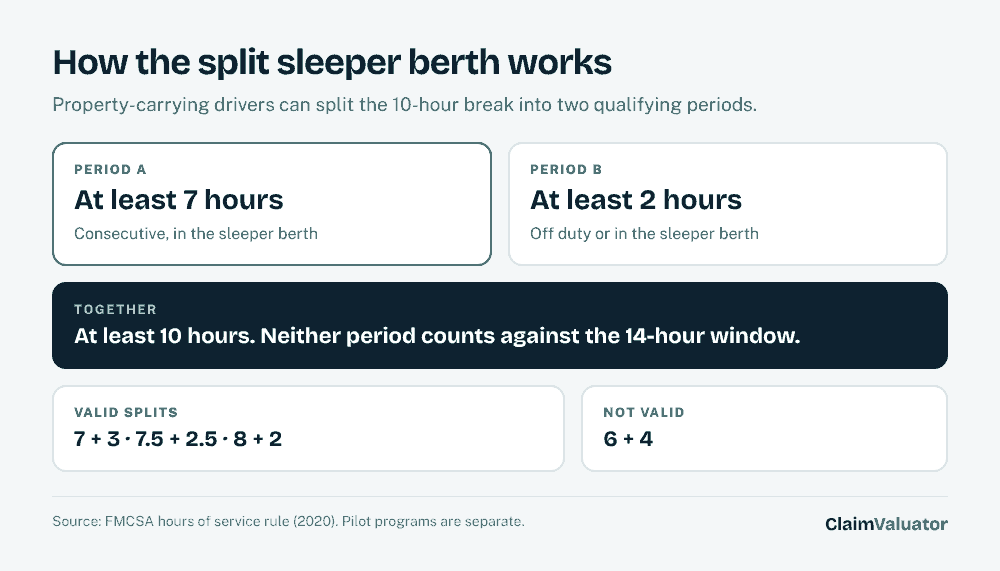
Instead of taking 10 consecutive hours off, drivers with a sleeper berth can split their off-duty time into two periods. Under the 2020 rule, one period must be at least 7 consecutive hours in the sleeper berth, and the other must be at least 2 hours, either off duty or in the berth. Together they must total at least 10 hours. When you pair them correctly, “neither period counts against the maximum 14-hour driving window” (FMCSA).
Common valid splits are 7 and 3, 7.5 and 2.5, and 8 and 2. The periods can be taken in either order. Your available driving and window time is recalculated from the end of the first qualifying period.
Common split sleeper mistakes
- Taking a short period of less than 2 hours and assuming it qualifies.
- Splitting 6 and 4. The longer period must be at least 7 hours in the berth.
- Counting the longer period as off duty in a truck without a sleeper berth.
- Forgetting that the 11-hour driving limit and the 30-minute break still apply between the two periods.
- Relying on an ELD’s calculation without understanding it. Check the recap before you drive.
FMCSA’s sleeper berth and split duty pilot programs
FMCSA is testing two changes. A Flexible Sleeper Berth pilot lets drivers split off-duty time into two periods in any combination, as long as they total at least 10 hours and one includes at least 5 consecutive hours in the berth. A Split Duty Period pilot tests letting drivers pause the 14-hour window for up to three hours a day. Both finished small pre-tests in 2026, and FMCSA says each full pilot will include 256 drivers in 2027 (FMCSA, August 2026). Unless you are enrolled in a pilot, the current rules apply.
Inspection violations and your safety record
Roadside inspection and crash records follow you. A driver’s Pre-Employment Screening Program (PSP) report shows the most recent 5 years of crash data and 3 years of roadside inspection data, and carriers check it before hiring. If a violation or crash on your record is wrong, you can ask FMCSA to review it through the DataQs system (Trucksafe summary of PSP). A lawyer can help with DataQs requests and with the court case behind a citation.
Enforcement priorities also change. Since June 2025, inspectors have again been placing drivers out of service for English-language proficiency violations, about 2,000 a month according to the American Trucking Associations (Transport Topics, July 2026).
Truck accidents: when you need a different kind of lawyer
If you were hurt in a crash, your claim may run through workers’ compensation, the other driver’s insurer or both. Our workers’ comp vs personal injury guide explains the difference, and the truck accident settlement calculator shows how these claims are valued. For an injury claim, our guide on how to choose a personal injury lawyer lists the questions to ask. If you are being sued after a crash, notify your carrier and its insurer right away.
Frequently asked questions
Do truck drivers need a lawyer for a speeding ticket?
Often, yes. Speeding 15 mph or more over the limit is a serious violation, and two serious violations within three years mean a 60-day CDL disqualification. CDL holders also cannot use deferral or traffic school to keep a conviction off their record.
Can a CDL driver take traffic school to keep a ticket off their record?
Generally no. Federal rules bar states from masking, deferring or diverting a CDL holder’s traffic convictions, other than parking, weight and vehicle defect violations.
How does the split sleeper berth work?
You take one period of at least 7 consecutive hours in the sleeper berth and another of at least 2 hours off duty or in the berth, totaling at least 10 hours. When paired, neither counts against the 14-hour window.
Is 6/4 a legal split sleeper berth?
Not under current rules. The longer period must be at least 7 hours in the berth. FMCSA’s pilot is testing other splits, but only for enrolled drivers.
Can a ticket in my personal car affect my CDL?
Yes. Serious violations in a personal vehicle can count toward disqualification if they lead to a license suspension or revocation, and major offenses like DUI in any vehicle can disqualify you.
How long do inspection violations stay on my record?
A PSP report shows 3 years of roadside inspection data and 5 years of crash data. You can challenge incorrect records through FMCSA’s DataQs system.
What does a CDL ticket lawyer cost?
It depends on the court and the charge. Many charge a flat fee for traffic tickets. Ask what is included, including court appearances, before you hire.
Sources
- 49 CFR 383.51: Disqualification of drivers
- 49 CFR 384.226: Prohibition on masking convictions
- FMCSA: Hours of Service final rule summary (2020)
- FMCSA: Hours of service pilot programs update (August 2026)
- Trucksafe: Understanding the Pre-Employment Screening Program
- Transport Topics: English proficiency enforcement (July 2026)
This article is general information, not legal advice. Traffic laws and penalties vary by state, and federal rules change. Talk to a licensed attorney in the state where you were cited.