Key points
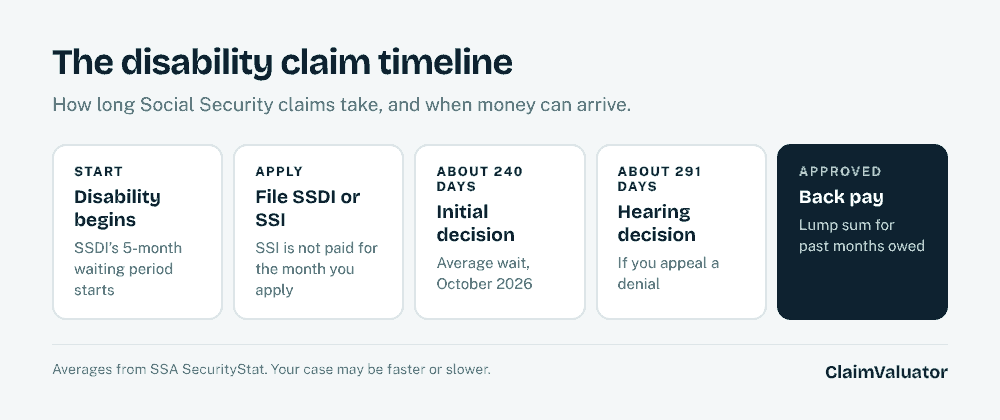
- Social Security disability decisions take months. SSA’s published averages in October 2026 were about 240 days for an initial decision and 291 days for a hearing decision.
- SSDI has a five-month waiting period after your disability begins, but approved claims include back pay. SSI has no waiting period but is never paid for the month you apply.
- While you wait, possible income sources include SSI presumptive disability payments, private or state disability insurance, workers’ comp, SNAP, cash assistance, unemployment and limited part-time work.
- In 2026 you can earn up to $1,690 a month ($2,830 if blind) without it counting as substantial gainful activity, though any work can affect how SSA sees your claim.
- Be wary of loans against future disability benefits. Social Security benefits generally cannot be signed over to a lender.
Applying for Social Security disability is often the start of a long wait. Social Security reported current average wait times of about 240 days for an initial disability decision, 243 days for reconsideration and 291 days for a hearing decision (SSA SecurityStat, October 2026). Rent, groceries and medical bills do not wait that long.
This guide covers eight realistic ways to bring in money while your SSDI or SSI claim is pending, the 2026 limits on work, how back pay works and how to ask Social Security to speed up your case.
How long you wait and what you get back
- SSDI (Social Security Disability Insurance) has a five-month waiting period that usually starts on the date your disability began. The first payment covers the sixth full month and is paid the following month. If you are approved, SSDI can also pay up to 12 months of retroactive benefits before your application date (AARP summary of SSA rules). The waiting period was eliminated for ALS in 2020.
- SSI (Supplemental Security Income) has no five-month wait, but “SSI benefits are not paid in the month that you first apply” (SSA Handbook § 2104).
- Back pay is paid once you are approved and can be a large lump sum. Our SSDI back pay calculator estimates what you may be owed.
2026 Social Security disability numbers
| Figure | 2026 amount |
|---|---|
| Cost-of-living adjustment | 2.8% |
| SSI federal payment, individual | $994 a month |
| SSI federal payment, couple | $1,491 a month |
| Substantial gainful activity (non-blind) | $1,690 a month |
| Substantial gainful activity (blind) | $2,830 a month |
| Trial work period month | $1,210 |
| Average SSDI benefit, disabled worker (estimate) | $1,630 a month |
Source: SSA 2026 COLA fact sheet. Some states add a supplement to the federal SSI payment.
8 options for income while waiting for disability
1. SSI presumptive disability payments
If you apply for SSI and your condition is so clear that you are very likely to be approved, Social Security can start paying before the final decision. These presumptive disability payments last up to six months, and you do not have to repay them if you are later found not disabled (SSA Handbook § 2188). Ask the SSA office whether your condition qualifies. You still have to meet SSI’s income and asset limits.
2. Private short-term or long-term disability insurance
Check whether you have disability coverage through your employer, a union or a policy you bought. Short-term policies typically pay for a few months and long-term policies start after an elimination period, often replacing a share of your salary. Many long-term policies require you to apply for SSDI and reduce their payment by what Social Security pays. Estimate a benefit with our long-term disability calculator.
3. State disability insurance or paid medical leave
California, Hawaii, New Jersey, New York, Rhode Island and Puerto Rico have long-running temporary disability insurance programs funded through payroll. A growing number of states also pay benefits for your own serious health condition through paid family and medical leave programs, including Washington, Massachusetts, Connecticut, Oregon and Colorado, with Delaware and Minnesota starting in January 2026 and Maine in May 2026 (Hylant summary of 2026 programs). These pay for a limited number of weeks, but they can bridge the first months.
4. Workers’ compensation
If your condition was caused by your job, file a workers’ comp claim. It can pay a weekly benefit, usually a share of your wages, while you are unable to work. Workers’ comp can reduce SSDI under an offset rule, so tell both agencies. See our workers’ comp weekly benefit calculator and our guide to workers’ comp vs personal injury claims.
5. SNAP food benefits and Medicaid
SNAP (food stamps) and Medicaid are based on income and household size, not on a disability decision, so you can apply right away. A 2025 federal law expanded SNAP time limits for adults without dependents to ages 18 to 64 and removed some exemptions (USDA guidance, July 2025). People who are medically certified as unable to work remain exempt from the work rules under federal SNAP law, so ask your doctor for documentation and tell the SNAP office about your condition.
6. Cash assistance and general assistance
Families with children may qualify for TANF cash assistance. Many states and counties run general assistance programs for adults without children, often aimed at people waiting on SSI. If you receive interim assistance and later win SSI, the state can be repaid from your SSI back pay with your written permission (SSA POMS on interim assistance). Dial 211 to find local programs, emergency rent help and utility assistance.
7. Unemployment benefits
Applying for unemployment does not automatically bar a disability claim, but it creates tension: unemployment requires you to say you can work and are looking for a job, while disability requires you to show you cannot work at the level SSA counts as substantial gainful activity. Judges can weigh that conflict. For SSI, unemployment counts as unearned income and reduces your payment. Talk to a disability lawyer before you apply for both.
8. Limited part-time work
You can work a little while your claim is pending, but keep earnings below the substantial gainful activity level, $1,690 a month in 2026 ($2,830 if blind). Earning above that usually leads to a denial for that period. Even work below the limit can be used as evidence of what you are able to do, so keep hours and duties modest and consistent with your medical records. For SSI, the first $65 of earnings plus half of the rest are excluded each month, along with a $20 general exclusion.
Should you borrow while waiting for disability?
Be careful. Companies that advertise loans or advances against future disability back pay often charge high fees, and Social Security benefits generally cannot be assigned or signed over to a lender under federal law. Safer options include hardship programs from your utility, landlord, lender or medical providers, a payment plan for medical bills, and help from family. If you take a loan, read the total cost carefully.
How to speed up a disability claim
Social Security fast-tracks some cases. These include terminal illness, conditions on the Compassionate Allowances list, veterans rated 100% permanent and total, military casualties, homelessness, people at risk of suicide or violence, and “dire need” (SSA HALLEX I-3-1-5). Dire need means you lack the income or resources to deal with an immediate threat to your health or safety, such as having no food, no access to needed medicine or medical care, or a home made uninhabitable by a utility shutoff. Ask in writing for a dire need review and attach proof, such as an eviction notice or shutoff letter.
Other practical steps: respond to every SSA letter on time, keep seeing your doctors, and make sure SSA has all your medical records. Missing records are one of the most common causes of delay.
Do you need a disability lawyer?
Disability lawyers and representatives are usually paid only if you win, from your back pay, and their fees are capped and must be approved by Social Security. A representative can gather medical evidence, request a dire need review and prepare you for a hearing. If your claim was denied, an appeal is often where representation matters most.
Frequently asked questions
Can I get cash assistance while waiting for disability?
Often, yes. Depending on your state and household, you may qualify for TANF, state or county general assistance, SNAP and Medicaid while your SSDI or SSI claim is pending.
Can I work while waiting for disability?
You can work a little, but keep earnings below $1,690 a month in 2026 ($2,830 if blind). Higher earnings usually mean SSA will find you are not disabled for that period.
Can I collect unemployment while applying for disability?
It is not automatically barred, but saying you can work for unemployment can conflict with your disability claim. Get advice before applying for both.
Do I have to pay back SSI presumptive disability payments?
Not if you are later found not disabled. Overpayments can still arise from non-medical issues, such as income or resources above the SSI limits.
How far back does SSDI back pay go?
Up to 12 months before your application date, depending on when your disability began, after the five-month waiting period.
How long does a disability decision take?
SSA’s averages in October 2026 were about 240 days for an initial decision, 243 days for reconsideration and 291 days for a hearing decision.
Are there loans for people waiting on disability?
Some lenders advertise them, but costs can be high and Social Security benefits generally cannot be assigned to a lender. Look at hardship programs and assistance first.
Sources
- Social Security Administration: 2026 Cost-of-Living Adjustment fact sheet
- Social Security Administration: SecurityStat, current average wait times
- SSA Handbook § 2188: Presumptive disability or blindness payments
- SSA Handbook § 2104: When are SSI benefits paid?
- SSA HALLEX I-3-1-5: Critical case procedures (dire need)
- SSA POMS: Interim assistance reimbursement
- AARP: How long does it take for Social Security disability benefits to start?
- USDA Food and Nutrition Service: SNAP ABAWD changes under the 2025 law
- Hylant: Paid family and medical leave programs starting in 2026
This article is general information, not legal or financial advice. Program rules and amounts change, and state programs vary. Contact Social Security, your state agencies or a disability attorney about your situation.