Key points
- You usually do not need a lawyer for a property-damage-only crash or a minor injury that heals quickly with clear fault.
- Talk to a car accident lawyer if you were seriously hurt, fault is disputed, the other driver is uninsured or underinsured, or a truck, rideshare or government vehicle was involved.
- Car accident lawyers work on contingency, usually around one-third of a settlement, and consultations are free.
- In 2023, 15.4% of U.S. drivers were uninsured and 33.4% were uninsured or underinsured, according to the Insurance Research Council.
- Deadlines matter: every state has a statute of limitations, and claims against government vehicles can need notice within months.
Most car crashes do not end up in court, and many do not need a lawyer at all. But some do, and the difference in what you recover can be large. U.S. traffic deaths fell to an estimated 36,640 in 2025, down 6.7% from 2024 (U.S. Department of Transportation, April 2026), yet millions of people are still injured in crashes every year and most of them deal with an insurance adjuster.
This guide helps you decide whether you need a car accident lawyer, what a lawyer actually does, what it costs, and when you can handle the claim yourself.
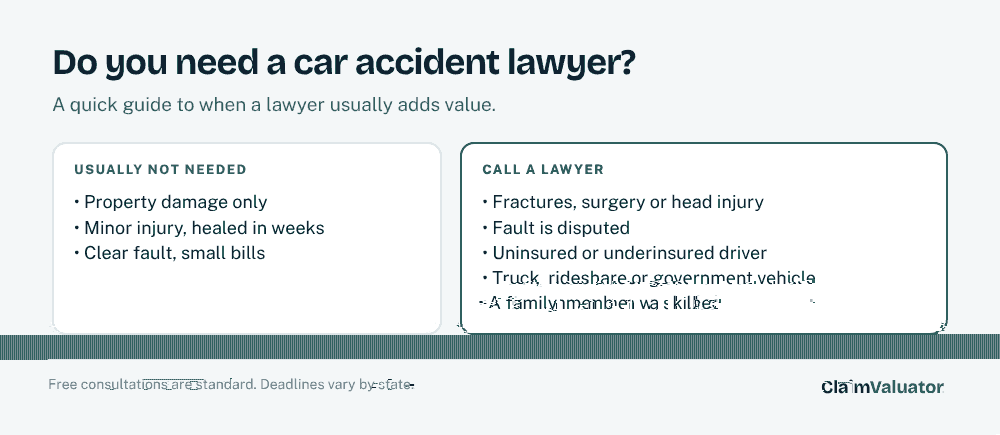
Do you need a car accident lawyer? A quick guide
| Your situation | Do you need a lawyer? | Why |
|---|---|---|
| Property damage only, nobody hurt | Usually no | Your insurer or the other driver’s insurer handles repairs, rental and diminished value. |
| Minor injury, healed within weeks, clear fault | Often no | Small medical bills and a short recovery are often settled directly with the insurer. |
| ER visit plus ongoing treatment or missed work | Get a free consultation | Value depends on future care and lost income, which insurers often discount. |
| Fractures, surgery, head injury or permanent harm | Yes | High-value claims need medical evidence, expert opinions and often a lawsuit. |
| Fault is disputed or you may share blame | Yes | Comparative negligence rules can cut or bar your recovery. |
| Other driver uninsured or underinsured | Usually yes | You may need to claim against your own UM/UIM coverage and stack policies. |
| Truck, rideshare, company or government vehicle | Yes | Multiple insurers, federal rules or short government notice deadlines apply. |
| A family member was killed | Yes | Wrongful death claims follow special rules on who can sue and for what. |
When a car accident lawyer is worth it
1. Your injuries are serious or still being treated
The biggest part of an injury claim is often future medical care, lost earning capacity and pain and suffering. Adjusters are trained to value those conservatively. A lawyer gathers medical opinions on your prognosis before negotiating, rather than settling while you are still treating. Our car accident settlement calculator shows how injury type and treatment length change the range.
2. Fault is disputed
In most states, your compensation is reduced by your share of the fault. In a few contributory negligence states, even 1% fault can bar recovery. Lawyers preserve evidence that settles fault arguments, including dashcam and traffic camera footage, the cars’ event data recorders, witness statements and scene measurements. See how fault changes a payout with the comparative fault calculator.
3. The other driver has little or no insurance
More than one in seven drivers (15.4%) were uninsured in 2023, and one in three (33.4%) were uninsured or underinsured (Insurance Research Council, February 2025). When the at-fault driver’s limits are too low, recovery may depend on your own uninsured or underinsured motorist coverage. Read our guides to policy limits and UM/UIM coverage and hit-and-run and uninsured driver claims.
4. A commercial or government vehicle was involved
Truck crashes involve federal safety rules, driver logs and corporate insurers. Rideshare claims depend on whether the app was on and whether a ride was in progress. Crashes with city, county or state vehicles often require a formal notice of claim within a few months, far sooner than the usual lawsuit deadline.
5. The insurer is stalling, lowballing or asking for a recorded statement
You generally do not have to give the other driver’s insurer a recorded statement. Our guide on recorded statements explains why. If the offer seems low, a lawyer can value the claim properly and, if needed, file suit before the deadline.
When you can handle the claim yourself
If nobody was hurt, or your injury was minor and healed quickly, you can usually settle on your own:
- Get the police report, photos, repair estimates and all medical bills and records.
- Track every out-of-pocket cost, including mileage to appointments and lost pay (our lost wages calculator helps).
- Send a written demand with your documents. Our demand letter generator builds one for you.
- Do not sign a release until you are finished treating. A release ends the claim permanently.
- If the offer seems unfair, test it with the settlement offer calculator or book a free consultation.
For the steps right after a crash, read what to do in the first 72 hours after a car accident.
What a car accident lawyer actually does
- Investigates the crash, preserves video and vehicle data, and interviews witnesses.
- Handles all calls and letters with insurers so you can focus on recovery.
- Collects medical records and opinions to prove the full cost of your injuries.
- Identifies every source of coverage, including the other driver, employers, your own UM/UIM, MedPay or PIP.
- Negotiates medical liens down so more of the settlement reaches you.
- Files a lawsuit before the statute of limitations runs out if the insurer will not pay fairly.
Car accident lawyer vs personal injury lawyer: is there a difference?
A car accident lawyer is a personal injury lawyer who focuses on vehicle crashes. The license is the same, but the day-to-day knowledge is not. Crash lawyers deal constantly with auto policies, UM/UIM and PIP coverage, vehicle data, accident reconstruction and the adjusters at the big auto insurers. For a truck crash, look for someone who also knows federal trucking rules. For a crash involving a bicycle or pedestrian, ask how many of those cases the lawyer has handled.
How much does a car accident lawyer cost?
Car accident lawyers almost always work on a contingency fee. You pay nothing up front, and the lawyer takes a percentage of the recovery, commonly about one-third before a lawsuit and up to 40% if the case is litigated. The agreement must be in writing and must say how case costs are handled (ABA Model Rule 1.5(c)). Use our attorney fee calculator to see what you would take home.
Is it worth the fee? The Insurance Research Council, an insurer-funded group, found that represented auto injury claimants received more in total but waited much longer, and kept slightly less per dollar of medical bills after fees ($1.40 versus $1.80) (IRC, July 2026). Represented cases also tend to be more serious and contested, so the comparison is not like for like. The practical rule: the more serious the injury and the more the insurer resists, the more a lawyer is worth.
How long do you have to hire a lawyer?
Each state sets a statute of limitations for injury lawsuits, commonly two or three years from the crash, though some are shorter and some longer. Government claims can require notice much sooner. No-fault states add their own rules about when you can step outside PIP and sue for pain and suffering (see no-fault states). Check your deadline with our statute of limitations calculator.
How to choose a car accident lawyer
Look for a lawyer who handles car crash cases every week, has taken cases to trial, will personally work on your file and puts the fee and costs in writing. Our full guide on how to choose a personal injury lawyer includes the questions to ask in a free consultation and the red flags to avoid. You can also search our Find an Expert directory.
Frequently asked questions
Is it worth getting a lawyer for a minor car accident?
Often not, if nobody was seriously hurt, fault is clear and your bills are small. It becomes worth it when injuries are ongoing, fault is disputed or the insurer is offering less than your documented losses.
How much does a car accident lawyer charge?
Usually a contingency fee of about 33% of a pre-suit settlement and up to 40% after a lawsuit is filed, plus case costs. You pay no fee if there is no recovery.
Do car accident lawyers offer free consultations?
Yes, almost all do. Use the consultation to ask what your claim is worth, who will handle it and how fees and costs work.
Can I hire a lawyer after I accept a settlement?
Generally no. Accepting a settlement usually means signing a release that ends the claim. Talk to a lawyer before you sign.
Should I talk to the other driver’s insurance company?
You can report the claim and give basic facts, but you usually do not have to give a recorded statement or sign a broad medical authorization.
What if I was partly at fault?
In most states you can still recover, reduced by your percentage of fault. A handful of states bar recovery if you were at fault at all, so get advice quickly.
How long does a car accident case take?
Simple claims can settle in months. Represented injury claims took a median of nearly 440 days to close in the Insurance Research Council’s study, and lawsuits can take longer.
Sources
- U.S. Department of Transportation: 2025 traffic fatality estimate (April 1, 2026)
- Insurance Research Council: Uninsured and underinsured motorists study (February 2025)
- Insurance Research Council: Auto Injury Insurance Claims, A Study of Increasing Claim Severity (July 2026)
- American Bar Association: Model Rule 1.5, Fees
This article is general information, not legal advice. Fault rules, insurance requirements and deadlines vary by state. Talk to a licensed attorney in your state about your situation.